


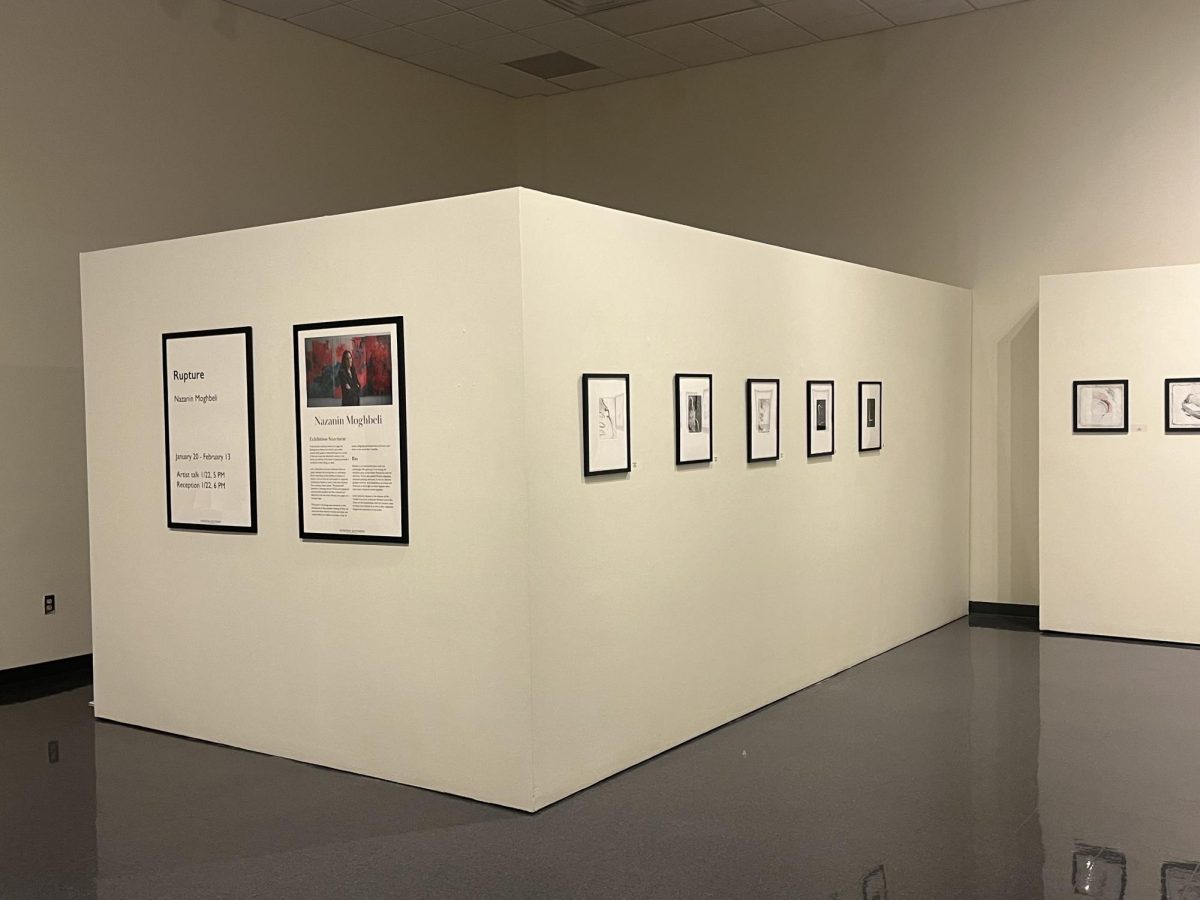
Dr. Nazanin Moghbeli presented her art at the Cragin Art Gallery on Thursday, Jan. 22. She talked to students and attendees at the presentation of her upbringing and how she came to be both an artist and cardiologist.
Being the daughter of two Iranian immigrant parents, as a teenager, when Nazanin Moghbeli confessed her desires of being an artist, naturally, her ambition was met with slight concern. “I don’t know if any of you are immigrants in the audience, but I had two Iranian parents, as immigrants, who really wanted to make sure that I had a way of making a living,” said Moghbeli to the attendees of her presentation and exhibition held in Corely Auditorium and the Cragin Art Gallery this past Thursday. Following her parent’s guidance, Moghbeli would pursue a career in the medical field, and she is currently the director of the cardiac unit at Einstein Medical Center. However, as seamlessly as blood flows through the veins of a heart, so did the calling of ink on a canvas.
Today, and represented in her exhibition Rupture, Dr. Moghbeli intertwines her practice of cardiology with her own artistic expression, something of which, was entirely kismet. “I made these without intentionally referencing any work related to my cardiology practice,” said Moghbeli when giving an overview of her early art pieces. “I think it was my subconscious, having the distance it needed from my practice to really process some of the things I had experienced.” Aligning two opposing fields of precision, Moghbeli finds meditation in expressing anatomy through curved lines and crumpled-up paper soaked in red ink. “I think that if I didn’t have a way of expressing the intensity of the experience, I think it would be very challenging for me as a person.”
Along with breathing symbolism, the artist’s work also captures influences from her cultural background. Growing up with a mother who practiced Islamic calligraphy, many of Moghbeli’s visions capture the strokes and lines reminiscent of the work she grew up seeing. “It’s so very different than my work, said Moghbeli, “but the movement, the flow, the shapes, the overlap, the moving lines, all of these things have really influenced me.” In her 2023 exhibition Unquiet Fury, Moghbeli called attention to the political climate of Iran, specifically the country’s uprise from women following the murder of a young woman who lacked to wear a hijab. “Through the years I’ve been influenced by the different things that are going on both in my life and in Iran, and in the circle of people that I surround myself with.”
It is this circle that Moghbeli wishes to expand, as she currently creates while sharing the intersection of medicine and art with both students and doctors. In her workshops, “Re-Frame: Fostering Resilience Through Art in Medical Education,” “Drawing to Decompress,” and “Seeing the End,” Moghbeli offers a space for individuals to discover the reflection that can materialize through art appreciation, uncovering that it is not art that makes a living, but the living that makes art.