
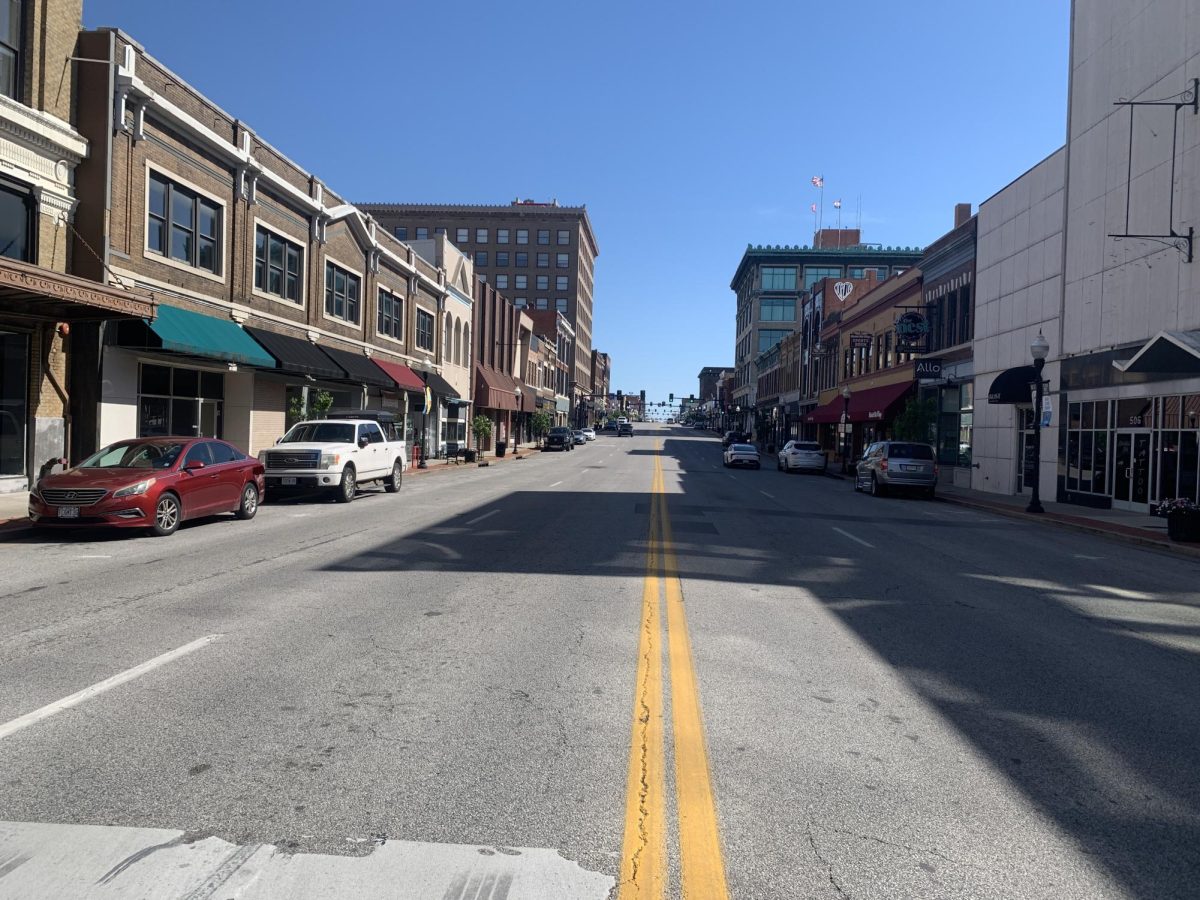




Beginning in 2024, the city of Joplin has implemented the use of Flock surveillance. Flock LPR readers, or license-plate capturing cameras, are currently being used in the city as an investigative aid for the Joplin Police Department. Since its introduction, Flock has been a subject of discourse. Regarding the data captured by this technology, naturally, community speculation has followed suite. Deflock Joplin, an organization against Flock’s use, advocates for the reconsideration of Flock’s integration in Joplin. Michael Williams, lead organizer of DeFlock, shares insight on Flock as a company, and plausible resident concerns.
“Our personal opinion is that this kind of system isn’t really compatible with the American values that most people hold,” says Williams. “We’re focusing on educating people on the system, letting them know it exists, then encouraging people to engage with their representatives, however they feel is appropriate after that.”
Graduating from MSSU in 2014 with a degree in Computer Forensics, Williams has had a lengthy career in Information Technology. Given this background, much of William’s research on Flock directly stems from his personal skills in tech-based data analyzing. Concerns with data breaches or privacy, such as those that surround Flock, are the same concerns that Williams strives to protect in his career field.
“In my job I have to protect data,” shares Williams. “And when people want to hold on to data, I try to limit how much we hold on to. Whereas this system is actually the opposite.”
Though Williams acknowledges validity in some of Joplin Police’s claims about the new technology, he encourages the department to reconsider Flock’s capabilities. Richard Pearson, Joplin’s Chief of Police, discussed the technology in a past discussion with The Chart. Pearson compares Flock’s capabilities to that of an officer.
“It’s basically the same as if I was to stand out on a street corner with my police radio and a notebook,” said Pearson when describing Flock’s assistance to the department.
In his research, Williams has analyzed that this comparison is often used as a selling vantage for Flock Safety, a privately-owned company. Targeting local agencies, and especially small towns, DeFlock’s research has shown a significant correlation between Flock and areas that could be, as Williams describes, “strapped for cash.”
“And, so they come in, and they go, “look, if you get our cameras, it’s like you get an extra X amount of officers,” explains Williams. “That’s kinda how they sell it.”
Following Flock’s installment, access to the software is a complete other ballpark. In Joplin’s case, monitoring of the cameras is intended for police use only, though Williams’s research poses skepticism to this claim. Along with this, Joplin’s Flock system is connected within the Flock network; a nationwide information-sharing database. Opting into Flock’s sharing feature grants the Joplin Police Department the ability to connect with other Flock systems across the country. DeFlock has found that around 75% of Flock customers utilize the information sharing feature.
“We have 50 pages of other agencies that have some sort of sharing relationship with Joplin and their data, and we know Joplin has access to 90,000 cameras from the search logs that exist,” says Williams. “When you have a network this big, you have to make sure there’s some sort of accountability. What we’ve seen is Flock is moving away from that accountability.”
In Joplin, Flock’s systems have already garnered recorded misuse by officers. After receiving a network audit from Washington State, DeFlock Joplin recognized suspicious activity occurring in the Joplin area. Following an investigation, it was confirmed that a Joplin police officer was abusing the technology.
Since this incident occurred, Flock’s network audits have been readjusted. According to Williams, these programmed audits do not contain enough information to ensure absolute protection of Flock cameras. Just recently, Flock introduced an automated alert system to detect abuse or suspicious activity within its systems. Previously, the system had none. In his research, Williams has observed many cases like Joplin’s.
“It keeps happening. It’s really ripe for that kind of thing,” states Williams. “We’re generating data everywhere. Our laws haven’t caught up, and the Fourth Amendment often does not apply. It’s just kind of a lot to me.”
For Joplin residents, or anyone interested in learning more about Flock, Williams recommends visiting HaveIBeenFlocked.com for more information. DeFlock Joplin also has a webpage, including a map of Flock cameras located in the surrounding Joplin area.
